Signed in as:
filler@godaddy.com
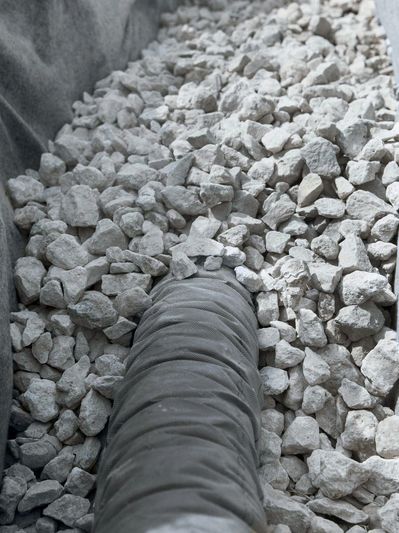
A soggy lawn, muddy paws, and standing water against your foundation aren't just frustrating—they are active threats to your home’s structural integrity. Across the Hampton Roads region and Northeast North Carolina, our unique coastal climate, heavy seasonal downpours, and challenging soil types make proper subsurface water management absolutely critical.
If you have areas of your yard that stay wet for days after a storm, a custom-engineered French drain system is the most reliable, permanent solution to redirect groundwater safely off your property.
Many homeowners assume their pooling water is just a grading issue, but the subsurface reality in our service areas requires a deeper approach. Traditional French drains fail around here if the contractor doesn't account for local soil conditions:
We don’t cut corners with pre-wrapped, cheap retail DIY products that collapse under the pressure of coastal soils. Our heavy-duty subsurface systems are built to withstand hydrostatic pressure (the force exerted by standing groundwater) and keep flowing clear for decades.
Our Process:
1. Precision Trenching & Slope Calibration: Excavation Phase.
Using specialized turf-friendly trenching machinery, we excavate a dedicated channel with a strict downward pitch toward a safe discharge point (such as a ditch, storm main, or pop-up emitter).
2. Non-Woven Geotextile Fabric Lining: Silt Protection.
We line the raw dirt trench with premium, commercial-grade non-woven filter fabric. This allows groundwater to seep in freely while permanently locking out fine silt, sand, and clay particles that clog inferior systems.
3. Solid Aggregate Bedding & Perforated Pipe: The Water Highway.
We lay a foundational bed of washed #57 drainage gravel, then install heavy-duty, smooth-interior perforated pipe (or custom heavy-wall manifold piping depending on your specific volume needs) with the drill holes facing downward to scoop rising groundwater from below.
4. Deep Aggregate Backfill & Encapsulation: Maximizing Void Space.
The entire trench is filled to the top with #57 gravel, completely surrounding the pipe. We fold the geotextile fabric over the top of the gravel like a burrito, totally encapsulating the drainage stone.
5.Structural Re-Grading & Finish Work: Restoration.
We backfill the top few inches with clean topsoil or stone and execute a precise fine-grade so your lawn can heal beautifully, leaving no trace of the heavy work beneath.
Why is a French drain better than a surface catch basin for my yard?
A catch basin only grabs surface water that pools directly on top of the grate. If your yard feels like a wet sponge or stays muddy for days, your problem may be subsurface saturation. A French drain acts like an underground sponge, constantly collecting and drawing down groundwater from the entire surrounding root zone, drying the soil completely out.
Where does the collected water actually go?
Every drainage system requires a viable exit strategy. Depending on local municipal building codes and your property layout, we route the water to a legal gravity discharge point—such as a roadside drainage swale, an existing storm sewer tie-in, a sump pump tank, or a heavy-duty pop-up emitter set up near the property line away from neighboring structures.
Will a French drain wash away my coastal sand or clog with clay?
Not when it's built right. This is why we use non-woven geotextile encapsulation. In sandy coastal soils (common in Virginia Beach and Currituck), unlined pipes fill with sand immediately. In heavy clay soils (Chesapeake and Suffolk), fine clay silt can blind a system. Our premium fabric shielding acts as a permanent barrier that only allows clean water through.
Because drainage solutions are never one-size-fits-all, we custom-engineer every single system to match the exact topography and soil conditions of your specific municipality.
Virginia Suburbs, Cities, & North Carolina Border Communities
• Virginia Beach
• Chesapeake
• Suffolk
• Norfolk
• Portsmouth
• Smithfield
• Carrollton
• Hampton
• Yorktown
• Moyock
• Currituck County
•Camden County